
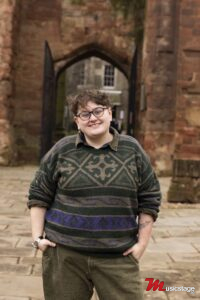
Press photo by Ethan Elliott
I met up with UK based author Wren James over a zoom call mid July to talk about their books and background.
Hi Wren! For those who don’t know you yet, tell us a bit about yourself!
– I started publishing books as Lauren James in 2015, and then as Wren James in 2023.
I began working on my first book in English class when I was 16, and I kept doing it during university.
Wren tells me they took a gap year to write and it really worked out, so it’s been their occupation since then. They write about LGBTQ+ characters and exciting parts of science. Wren laughingly tells me that they never had a boss!
Wren’s books take place in a wide range of genres, the debut The Next Together and the following The Last Beginning are about true love and reincarnation, there’s space travelers (The Loneliest Girl in the Universe), a droid and a prince ( The Starlight Watchmaker and The Deep-Sea Duke), ghosts (The Reckless Afterlife of Harriet Stoker), kids with supernatural powers (Green Rising) murder mystery (Last Seen Online), an apocalyptic future (The Quiet at the End of the World), a climate handbook for writers (The Climate-Conscious Writers Handbook) and a magical fantasy comic (The Victors). Besides this, Wren has been involved in Alice Oseman’s comic Heartstopper, by writing a mini comic about when Nick and Charlie meet icon Jack Maddox (Thank you very much for this!!!), the text on the Heartstopper fan cards, and they worked with Alice in the writers room on the script for the Heartstopper tv-series.
Is there a hidden trend in all this?
– I’m always interested in characters that are affected by what’s happening around them and characters that struggle with their identity. Like: what is it that’s separating our identity from other creatures? I’m writing Sci-Fi and adding parts from real life and topics that need to be discussed.
Wren describes the genre as speculative fiction and high concept ideas. And give the example: would the world be the same if all teenagers had magic powers?
Wren tells me they feel the frame to work in is allowing, they can mostly write whatever they want as long as it is for teenagers. And they’re allowed to jump more between plots than what historical writers are allowed to, just to mention one example.
The breadth in genres isn’t an intentional decision. Wren describes it as a new idea takes over, it can be an idea from reading mythology or from the climate alliance for example, like what would be happening if we give power to teenagers, what could they do? Like Greta Thunberg with powers, Wren drops as an example.
I also learn that there’s an easter egg that unites the books, a fictional story called Loch and Ness that appears in some way in all books.
– Maybe I’ll write that story some day… Wren thinks out loud. They continue with a laugh: I get bored quite easily and could never do like Alice (Oseman) and publish every day for 2000 pages through 6 volumes!
You’ve written two series, of two books each, and the rest of your books stands alone. Do you have any sequel/prequel planned for any of your books?
– Yes! There will be a sequel for the Loneliest Girl in the Universe, one day. But my publisher only publishes kids books, and my character will be grown up in that book so that needs to be sorted out. And my next book will be a trilogy! Wren says enthusiastically, and then stops themself with a laugh, and apologizes because they can’t tell me more about that project yet.
You started writing your first book when you were 16 years old, and got it published!
– I was really lucky and the timing was right. John Green and Rainbow Rowell, both America based authors, had published their first young adult books and publishers in the United Kingdom had just realised they wanted to find their own writers for the genre so there wasn’t much competition back then.
Wren tells me it’s much harder these days to come through as a writer of young adult books, as there are so many more writers now.
I also learned that being a huge reader really helped them in their journey to be a writer.
– Reading about 300 books a year for fun was the best investment of my life, Wren states, and the books I write are books I want to read that don’t exist.
The Victors
Wren’s latest book, the Victors is a comic, and I get to hear that a big part of doing a comic came from Heartstopper. Wren and Alice go way back as friends and writing colleagues, and as told, Wren joined Alice in the writers room for the Heartstopper TV- script.
– Writing for the screen is so much bigger compared to writing a book, you need to give instructions to the cast and crew on everything: like how to react, what they think, what the environment gives and the details and descriptions on a deep level, just using words, Wren explains. And making a comic and not doing the illustrations by yourself is a lot like that, according to Wren.
– You need to tell everything in words, that later will be seen drawn in the panels.
Something Wren really appreciated about being a part of the writers room for Heartstopper and during the work with The Victors is being in a team. Being a writer is lonely usually but for the script and the comic they worked as a team, talking and processing together and celebrating achievements together! Wren says.
How did your process/structure look with Beth for The Victors?
– It’s rare to have one writer and one illustrator working together, there’s not many examples of scripts for comic books to look at and get inspired by so I had to invent that part first.
The process started with Wren making the script using a combination of rough sketches and the written script broken down in double-pages spread, left and right hand side.
The layout and number of panels for each page spread gets planned, and even before Wren even started writing a word they knew they had 225 pages to fit the story into.
I’m learning from Wren that you can’t go over just one double page in a book, if you need one more page you have to add in a load more of pages, because it follows some standards.
Wren and their editor Non Pratt at Walker worked together on the script Wren made until they were happy with the plot. When the illustrator starts to add art into the comic there is no going back for changes in the script.
The designer Jamie then made a layout for every page placing out the panels and the text that’s going into the comic (in black) and comments about what’s going to be illustrated (in pink) on every double-spread. When the whole book was done with panels and text, Beth took over for the illustrations, by making sketches blocking each panel, giving a loose idea of who will be in each panel and how the pages will turn out. When Beth’s done they looked into the book, giving feedback like: don’t use the same pose here, more of this! Show the phone here, alter the panels there.
The process gets smoother after a while when they all learn together what they want the pages to look like, but it’s time consuming and the rough sketches are a way to not waste too much hard work when changes need to be done to the art.
The last step for Beth is revising the feedback and sketches, to create the final book layout.
The Victors start after the big war has taken place, and the world tries to get back to a new normal. It’s a bit unusual to start after the big events?
– I was much into fandoms as a teenager and got invested in “what comes next?”, thinking about how they would handle the trauma after all that had happened, that you never got to see. The tv-serie What we do in the shadows: has been a big inspiration for me where a documentary team follows the life of a group of vampires. The way they don’t do much because they live forever, so nothing means anything to them.
– So the idea of a hero that saved the world, who got the new world named by him, being someone that everyone wants to be friends with, and him being someone that really doesn’t want to be part of it at all, came to my mind.
-And adding important topics like the way war affects kids, the way queer- and trans persons are affected by getting to hear others thoughts about them, how they’re being affected by who others see them as, and expect them to be.
And not to forget, the importance of having true friends who see YOU as YOU want to be seen, Wren adds.
In the Loneliest Girl in the Universe you have an interesting background story about a mathematical problem about time, space and speed. I’m not even gonna pretend that I understand it, but if you put one identical twin in a spaceship leaving at speed A, and then later send off the other twin in a spaceship that is faster, at their crossing point they will not look the same anymore because of the difference in time and speed.
How did that turn into a book…?
– Looking back to when I first did the algebra problem, I remember that I was thinking: why did they just send one person? And why did they then send the other? How would they be affected by this? And how would the mathematics around this work? Wren tells me.
And it seems like the thought really got stuck with Wren because they told me about different scenarios they thought of for the plot, and one of those included murders on the ship…
So the result of a math problem turned into one legendary spreadsheet to solve the mathematics and a science fiction romantic thriller with a killer twist.
– And my degree has been very useful through this, Wren adds with a laugh.
In The Quiet at the End of the World you handle the heavy subject of knowing you are the last of mankind and nothing you do will change it. How do you find strength and interest to do anything meaningful knowing that? I would just lay down and wait…
Wren laughs and tells me they would lay down too, and continues:
– I read that human extinction will come at some point in the future. That’s gonna happen. And it got me thinking of the meaning of life, when you know there’s no future for humanity. Many kids and teens do think these thoughts now, not knowing how to get a job, how the environment will be and with the climate changes. And I am a big believer in the community, in love and support!
Wren continues: I read Station Eleven, a book where a Shakespeare troupe travels to perform to the people that’s left on earth after a crisis, and I loved that simple message in there: humans are good.
– I read a lot of dark books, so I’m gonna be an optimist while writing dystopia! Wren states, and admits: I have to struggle to do the positive part, but it’s so important to keep books positive! That’s one of the big things with Heartstopper for example. And I feel like there’s some kind of author responsibility to write what people need to read…
– And for myself, the books take me such a long time to write, that I need them to be positive so I can keep opening them and keep working on them.
So you used your education in Chemistry and Physics for your books, what was the goal with your education before you got published, and still were in school?
I wanted to be a PhD scientist like my granddad. He made the solar panel on calculators and I wanted to work in a lab like him, Wren tells me and continues:
– Science is different from creative writing but it still uses the same side of the brain, and both things are like solving puzzles. Wren makes a comparison of puzzling with how they got The Victors story in on those available 225 pages.
Another example where the education came in handy were with the work of the The Climate-Conscious Writers Handbook. It started with The Climate Fiction League that was founded by Wren in 2022, a group of authors who believe in the necessity of climate action, immediately and absolutely.
The league exists to consult writers to add climate awareness in fictions, by talking about things you can do or can change in ordinary life, since the opposite, scare tactics don’t get people to change anything, it just shuts them down. The book, The Climate-Conscious Writers Handbook created by Wren is supposed to be a helpful tool for writers who want to talk about climate change, and to support them through the writing process. It’s designed as a notebook to use while writing.
Wren didn’t know proper politics at the start, so they had to do a deep dive for more knowledge, which resulted in reading 30 pieces of non fiction, about climate change. As they didn’t want to forget the knowledge, they decided to collect it and save it in a non-scary format. From what I saw (when Wren happily went to get the book and showed it to me over the screen, to help me understand the book) it’s like a planner with facts and key talking points, spaces for your notes and with references in the bottom for where to go to read more.
– It’s so rewarding to have created that, and to see how it’s been used. I’m so glad for it now, but I probably wouldn’t have done it in the first place if I knew about all the hard work it took, Wren confesses with a laugh.
If you think of your characters from your books, who do you relate to the most?
-All of them, for they all have a part of my personality. It’s hard to write a character that doesn’t have me. I’m writing about things I’ve gone through in some way. But Romy in The Loneliest Girl in the Universe is me trying to figure me out and who I wanna be, like should I shave my legs? Should I read science? It’s the Wren nonbinary true authentic self.
And who is your favorite?
– Gottie in Last Seen Online. Gottie is the writer of an online fan blog, and I did all the insta accounts and I was playing around with fandom while doing the book (you can read the online blog here – https://gottiewrites.com/ ). It’s always gonna be a favorite. Gottie is outrageous, caring about how hot her favorite actor is…
I posted it chapter by chapter and it turned into a full novel.
What happens next?
– I’m doing a graphic novel that is totally different from The Victors, and it is so fun!
And there is the upcoming trilogy.
Links:
Wren shares the interesting process of making the script for The Victors at their substack:
https://wrenjameswriter.substack.com/p/from-script-to-graphic-novel
https://wrenjameswriter.substack.com/p/part-2-from-script-to-graphic-novel
The Climate Fiction Writers League:
https://climate-fiction.org/
Wren pitching their books in 90 seconds:
https://www.instagram.com/reel/DUirFtajErK/?igsh=ZmxkZ2N5ODZrM2o3